
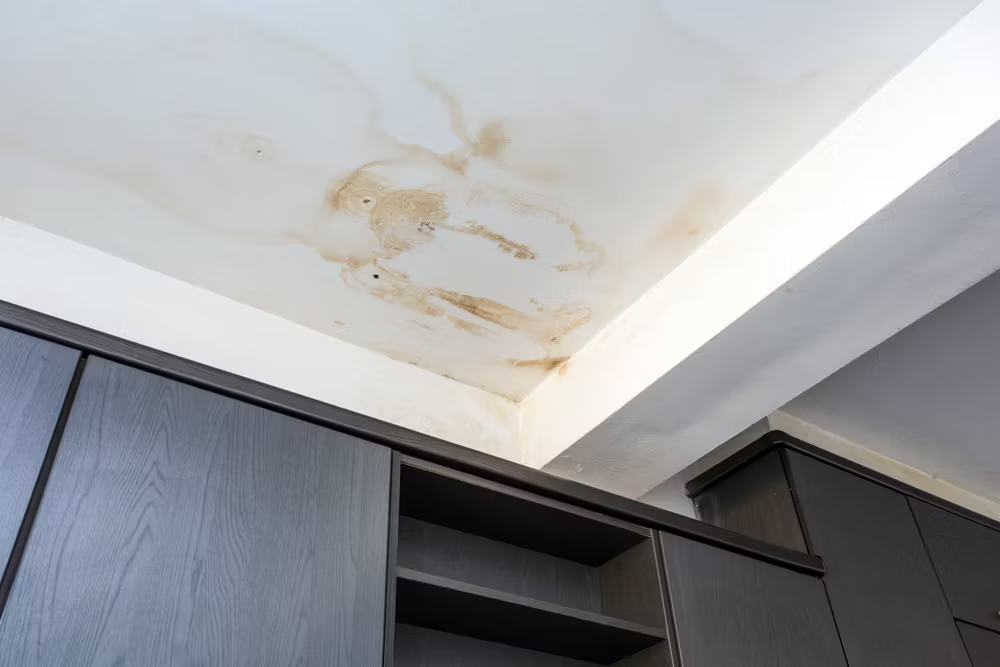
The signs of water seepage in walls often appear long before homeowners recognise what they are witnessing. A small dark patch near a window frame, a faint musty smell in a corner cupboard, paint that bubbles almost imperceptibly along a skirting board. These subtle indicators tell a story that unfolds beneath the surface, in the hidden spaces between brick and plaster, where moisture moves through pathways invisible to casual observation.
The Geography of Interior Moisture
To understand wall seepage, one must first appreciate the architecture of water itself. Water molecules, drawn by capillary action and gravity, travel through materials with surprising determination. In Singapore’s tropical environment, where relative humidity hovers between 70 and 90 per cent throughout the year, walls exist in a state of constant negotiation with atmospheric moisture.
The porous nature of building materials creates what we might call a hydraulic landscape within your walls. Concrete blocks, mortar joints, and even paint layers possess varying degrees of permeability. When external conditions align with internal vulnerabilities, water finds its route. As one building diagnostics specialist observed, “Most homeowners look at walls as solid barriers, but water sees them as three-dimensional pathways with countless routes of travel.”
The Invisible Origins
What homeowners often miss is that visible water seepage in walls rarely originates at the point where it appears. Water might enter through a compromised roof tile five metres above the stain you notice in your bedroom. It could seep through an exterior wall crack, then travel horizontally along a beam before descending through a column and emerging two floors below its entry point.
This disconnection between cause and effect explains why superficial repairs frequently fail. Treating the visible symptom whilst the source remains active merely redirects the water to find another exit point. Within months, new stains appear in adjacent areas, and frustrated homeowners conclude their walls are inherently problematic rather than recognising incomplete diagnosis.
Critical Areas Requiring Examination
Certain locations within buildings prove particularly vulnerable to wall water seepage. These zones deserve methodical attention:
- External wall junctions, especially where different materials meet
- Areas surrounding window and door frames
- Bathroom walls, particularly those backing onto external facades
- Kitchen walls adjacent to plumbing installations
- Basement or ground floor walls in contact with soil
- Parapet walls and rooftop boundaries
- Air conditioning condenser mounting points
Each location presents distinct challenges. Consider bathroom walls, which face moisture pressure from both directions. Interior humidity from showers combines with potential external weather exposure. The waterproofing membrane, if improperly installed or degraded, becomes the critical failure point. Yet many homeowners focus solely on retiling the bathroom surface without investigating whether the underlying membrane remains intact.
The Capillary Action Phenomenon
One particularly insidious form of water seepage in walls occurs through capillary rise from ground level. In older Singapore buildings constructed before modern damp-proofing standards, moisture from soil travels upward through masonry and concrete. This rising damp creates a characteristic pattern: walls appear increasingly damp from floor level upward, sometimes reaching heights of one to two metres.
The salt deposits that accompany rising damp add another dimension to the problem. As water evaporates from wall surfaces, it leaves behind mineral salts that form white crystalline deposits. These salts are not merely cosmetic issues. They expand within porous materials, creating internal pressure that degrades mortar joints and spalls concrete surfaces. The cycle becomes self-perpetuating as damaged materials become more permeable to further moisture intrusion.
Environmental Factors Specific to Singapore
Singapore’s position one degree north of the equator creates unique conditions for wall seepage. The absence of seasonal variation means walls never experience the drying periods that occur in temperate climates. Continuous exposure to high humidity prevents complete drying cycles, and moisture trapped within wall cavities remains there indefinitely.
Monsoon rains add another variable. During intense rainfall events, wind-driven rain strikes building facades with considerable force. Water penetrates through hairline cracks invisible during dry conditions. A building surveyor with three decades of experience noted, “After every major storm, we receive calls about mysterious leaks. The homeowners insist their walls were fine yesterday. What they miss is that the weakness was always there, waiting for the right conditions to reveal itself.”
Diagnostic Approaches
Professional investigation of water seepage in walls employs several methodologies:
- Moisture metres that measure water content within materials
- Thermal imaging cameras revealing temperature differentials indicating dampness
- Tracer dye tests to map water pathways
- Invasive inspection through strategic wall openings
- External facade rappelling inspections for high-rise buildings
These techniques reveal patterns invisible to surface observation. Thermal imaging particularly demonstrates how moisture creates thermal signatures, as damp areas display different heat retention properties than dry sections. The resulting images resemble geological surveys, mapping moisture deposits the way seismologists map underground strata.
Prevention Through Understanding
The key to preventing wall water seepage lies not in reactive repairs but in systematic understanding. Walls are dynamic systems responding to environmental pressures, structural movements, and material aging. Regular inspection protocols, attention to early warning signs, and comprehensive repairs addressing root causes rather than symptoms transform how we relate to our built environment.
When homeowners shift from seeing walls as static barriers to understanding them as permeable membranes requiring maintenance, they gain agency over problems that previously seemed mysterious and insurmountable. This perspective change, perhaps more than any single repair technique, offers the most reliable path toward managing water seepage in walls.
