
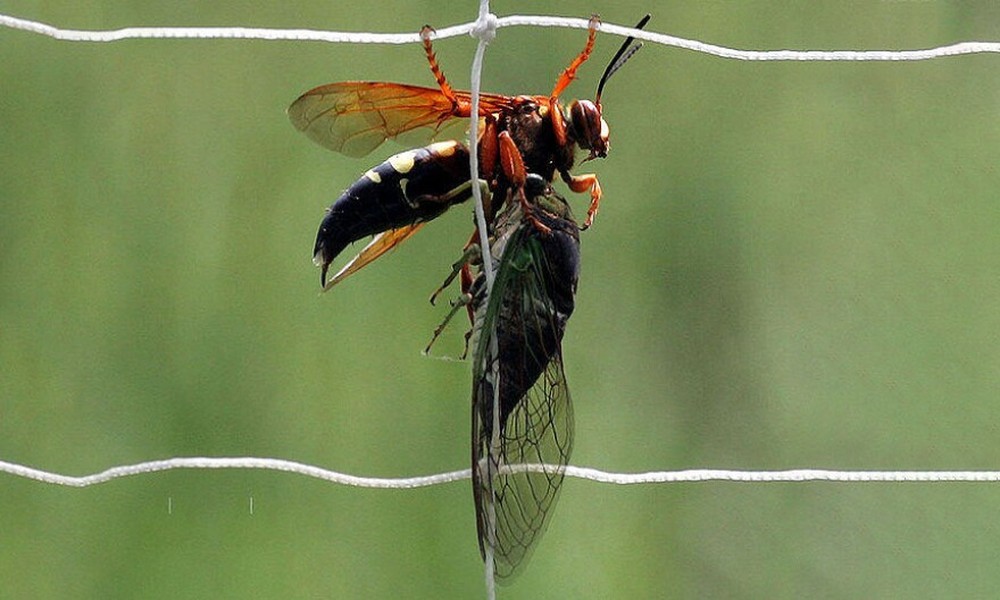
Late July and August bring the annual flood of calls about large wasps hovering over driveways, burrowing into bare lawn patches, or nesting under deck soffits. Most of the calls are about cicada killers, which look terrifying and are almost completely harmless. Some of the calls involve species that deserve the concern. The difference matters because the wrong response to each can turn a minor yard nuisance into a dangerous stinging incident, or trigger an expensive removal for an insect that was going to be gone in three weeks anyway. Kansas City pest control companies that work stinging insect calls routinely, including ZipZap Termite & Pest Control in Lawson, see the same identification confusion every summer, and the useful question is which species a homeowner is actually looking at.
Cicada Killers: Big, Dramatic, and Nearly Harmless
The eastern cicada killer (Sphecius speciosus) is the wasp most often mistaken for something dangerous. Adults reach 1.5 to 2 inches long, about double the size of a paper wasp, with reddish-brown bodies, yellow banding on the abdomen, and amber-tinted wings. A single female cruising low over a lawn on a warm afternoon is an arresting sight.
The biology makes them one of the least aggressive wasps in Missouri. Cicada killers are solitary, not social. Each female digs her own burrow in well-drained, sparsely vegetated soil (bare lawn patches, edges of sidewalks and driveways, sandy garden beds), provisions it with paralyzed cicadas, and lays eggs. She does not defend a shared colony, and her sting is reserved almost entirely for subduing prey. Unprovoked stings on humans are uncommon enough that most entomologists go their careers without recording one from this species.
The males, which do the hovering that homeowners usually notice, cannot sting at all. Male wasps across all species lack the ovipositor that became the stinger in females. The threat displays, dogfights with other males, and approach flights toward anything that moves through the territory are aggression without payload.
Cicada killer activity peaks in late July and runs through mid-to-late August. The adults die off at the end of the season, the next generation overwinters as larvae in the burrows, and the cycle repeats on roughly the same ground the following July.
Management is optional for most homeowners. Reseeding bare patches, improving turf density, and correcting drainage in the bare zones the wasps prefer eliminates the habitat they need. Broad pesticide application is rarely warranted.
Yellowjackets: The Species That Sends People to the ER
The eastern yellowjacket (Vespula maculifrons) and the German yellowjacket (Vespula germanica) are the two species responsible for most painful summer stinging incidents in the Kansas City metro. They are smaller than cicada killers, typically 1/2 inch, with sharp yellow and black banding and a compact, muscular appearance.
Yellowjackets are social. A single colony can reach several thousand workers by late summer, and they defend the nest aggressively. Unlike cicada killers, a yellowjacket can sting repeatedly without losing the stinger, and the colony alarm pheromone recruits additional defenders within seconds of any perceived threat.
Nesting locations matter for the risk profile. Eastern yellowjackets build below-ground nests in abandoned rodent burrows, under landscape timbers, inside stone walls, or in voids beneath porch steps. A homeowner mowing over a nest entrance is the single most common stinging incident scenario in Missouri from late July through September. German yellowjackets, an introduced species, more often nest in wall voids and attic cavities, which creates an entirely different kind of hazard when the structure has to be treated.
Colony size climbs through the summer and peaks in September. An ignored yellowjacket nest found in June is a much larger problem by Labor Day.
Professional removal is strongly recommended for any yellowjacket nest within about 20 feet of a regularly used area (patio, walkway, play structure, mowing path), and required for any nest inside a structure.
Bald-Faced Hornets: The Papery Football Nests
The bald-faced hornet (Dolichovespula maculata) is not actually a hornet, taxonomically. It is a large aerial yellowjacket, predominantly black with white markings on the face and thorax, reaching 3/4 inch. What distinguishes them is the nest: a gray, papery, football- or teardrop-shaped construction built in trees, under eaves, attached to siding, or occasionally inside dense shrubbery.
Bald-faced hornet colonies are smaller than yellowjacket colonies, typically several hundred workers at peak, but they are more aggressive in defense of the nest. The documented safe approach distance is substantially larger than for paper wasps, and they can spray venom at the eyes of a perceived threat, a defensive behavior uncommon in most other Missouri wasps.
Nest location determines the treatment decision. A bald-faced hornet nest high in a tree 40 feet from the house usually warrants no action, since the colony dies at first frost and the nest is not reused. A nest attached to a gable, soffit, or a second-story window frame is a different calculation.
Paper Wasps and Mud Daubers: The Ones to Leave Alone
The northern paper wasp (Polistes fuscatus) and the European paper wasp (Polistes dominula) are the slender, long-legged wasps that build the open, umbrella-shaped gray nests under eaves, inside grill covers, and in garage corners. They sting if the nest is disturbed, but rarely otherwise, and small paper wasp colonies (typically 15 to 30 workers) serve a meaningful role in garden pest control by hunting caterpillars.
Mud daubers are solitary, like cicada killers, and build the distinctive tubular mud nests seen on foundations, under decks, and inside sheds. They almost never sting humans and do not defend nests. Empty mud dauber tubes are often colonized by other insects, including tiny parasitic wasps, which is useful information for anyone worrying about activity around an old nest.
Neither group typically warrants treatment unless the nest is in a high-contact location.
When Kansas City Pest Control Work Actually Makes Sense
The decision rests on three factors rather than the intimidating appearance of the wasp.
Nest type and species. A social colony of yellowjackets or bald-faced hornets within 20 feet of regular activity is a different calculation than a solitary cicada killer or mud dauber.
Nest location. Any nest inside a structure, including wall voids, attic spaces, soffit returns, or chimney chases, requires professional treatment because DIY application often forces defensive wasps into the living space through light fixtures or vents.
Household circumstances. Members of the household with known wasp sting allergies, young children in the yard, or pets that hunt flying insects shift the calculation significantly toward early professional intervention.
A Kansas City pest control inspection typically identifies the species within minutes, locates the nest precisely, and treats with formulations and timing that account for colony defensive behavior. Evening applications are standard because foragers return at dusk and colony-wide exposure is substantially higher than during daytime treatment.
The Short Version
Most of the large, dramatic wasps Kansas City homeowners encounter from June through September are harmless or nearly so. Cicada killers, mud daubers, and distant paper wasp colonies deserve observation rather than extermination. Yellowjackets, bald-faced hornets near the house, and any wasp nesting inside the structure are a different category and warrant professional attention. For homeowners uncertain about what they are looking at, a Kansas City pest control provider such as ZipZap Termite & Pest Control can identify the species, assess the risk, and handle the cases that actually need intervention while leaving the ones that do not.
