
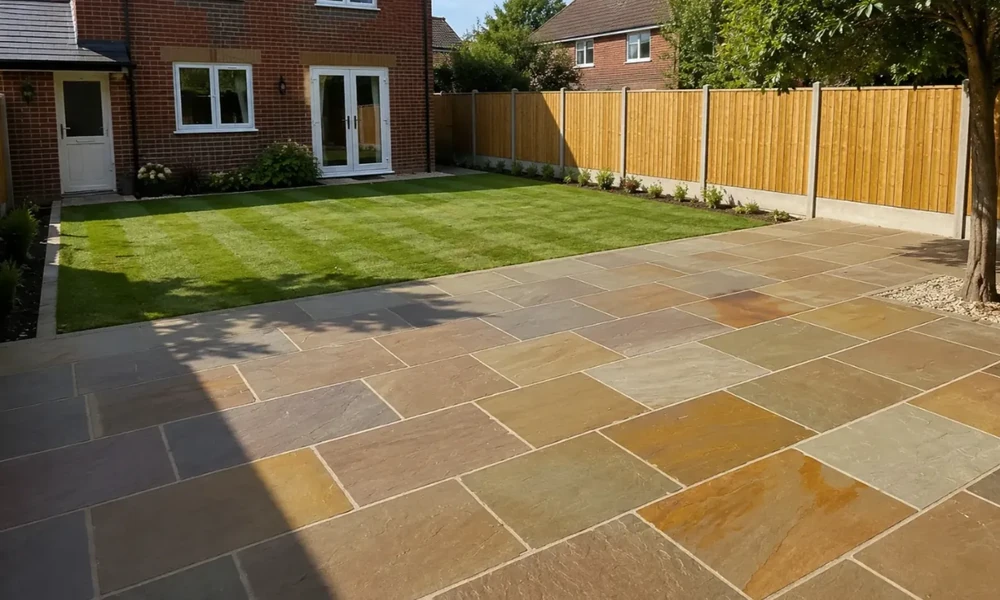
Renovating an existing patio is not simply a matter of replacing old slabs with a newer colour. The paving must suit the property, the existing levels, the garden design and the way the outdoor space will be used.
Indian sandstone remains a practical choice for UK patio renovations because it combines natural colour variation, genuine stone texture and a wide choice of slab formats. However, homeowners must decide whether a traditional riven finish or a more refined smooth finish is better suited to the project.
This second part of our Indian sandstone garden series explains how to compare the two finishes, when to use large-format paving and what should be assessed before an old patio is replaced.
Why Use Indian Sandstone for a Patio Renovation?
Indian sandstone paving is suitable for renovating patios, garden paths, terraces and outdoor seating areas. Unlike printed paving products, every slab has its own natural mineral structure, colour movement and surface character.
Indian sandstone is commonly chosen for renovation projects because it offers:
- Natural colour variation
- Traditional and contemporary finishes
- Large-format and mixed-size paving options
- Good compatibility with UK brick and rendered properties
- A surface that develops character rather than looking factory-repeated
- Options for both informal gardens and structured modern patios
The correct product still depends on the architecture of the property and the level of surface variation the homeowner is prepared to accept.
Riven Sandstone or Smooth Sandstone?
The main distinction is not the stone itself but the way its upper surface has been finished.
Riven sandstone is split along the natural layers of the stone. Smooth sandstone is processed to create a flatter and more refined surface. Neither finish is universally better. They produce different visual effects and require different design decisions.
What Is Riven Indian Sandstone?
Riven sandstone has a naturally cleft surface with shallow ridges, depressions and mineral movement. The texture varies between slabs because it follows the natural bedding planes of the stone.
Advantages of Riven Sandstone
- Strong natural-stone character
- Compatible with traditional and rustic gardens
- Helps disguise minor surface marks and everyday weathering
- Works particularly well with mixed-size patio layouts
- Provides visible texture in both dry and wet conditions
Points to Consider
- The surface will not be completely flat.
- Individual slabs may have more pronounced texture than others.
- Furniture may require careful positioning on heavily textured areas.
- Natural variation should be blended during installation.
- Poor laying can exaggerate unevenness between adjacent slabs.
Riven sandstone is generally the stronger choice where the aim is to preserve a traditional garden character rather than create a highly controlled architectural surface.
What Is Smooth Indian Sandstone?
Smooth sandstone paving is processed to reduce the prominent natural ridges found on standard riven slabs. Depending on the product, the stone may be honed, sandblasted, brushed or lightly textured after smoothing.
The result is a flatter and more refined appearance while retaining the natural colour and mineral variation of sandstone.
Advantages of Smooth Sandstone
- Cleaner and more contemporary appearance
- More suitable for modern extensions and renovated properties
- Provides a more stable surface for tables and garden furniture
- Allows large-format layouts to appear more structured
- Retains natural stone variation without a heavily rustic texture
Points to Consider
- A smooth finish does not mean the slabs are identical.
- Natural colour and mineral markings remain visible.
- Very pale stone may show dirt and organic deposits more readily.
- The paving must still provide an appropriate external-use surface.
- Incorrect installation may allow lippage to remain visible.
Smooth sandstone is normally more suitable where the renovation combines a traditional building material with a cleaner contemporary layout.
Riven vs Smooth Sandstone Comparison
| Feature | Riven sandstone | Smooth sandstone |
|---|---|---|
| Surface character | Naturally cleft and textured | Flatter and more refined |
| Visual style | Traditional, rustic and informal | Contemporary, structured and understated |
| Colour variation | Clearly visible | Clearly visible |
| Furniture stability | Depends on the degree of riven texture | Generally more stable |
| Best property match | Period homes, cottages and traditional brick | Renovated homes, extensions and modern garden rooms |
| Installation appearance | More forgiving of natural surface movement | Requires careful level control |
| Typical design effect | Natural and varied | Clean but still natural |
Which Finish Is Better for Renovating an Old Patio?
Riven sandstone is usually more appropriate when the existing garden has traditional brickwork, mature planting, timber structures or irregular boundaries. Its natural surface works well where the patio is intended to look established rather than newly manufactured.
Smooth sandstone is often more suitable when the renovation includes new doors, rendered walls, aluminium frames, modern fencing or a contemporary extension. The flatter surface helps connect natural stone with cleaner architectural details.
The decision should not be based on appearance alone. Consider how the patio will be used.
- Choose riven sandstone for stronger natural texture and traditional character.
- Choose smooth sandstone for dining furniture and a more controlled appearance.
- Choose either finish only after checking its wet appearance.
- Do not expect natural sandstone to look as uniform as porcelain.
Is 900 × 600 mm Sandstone Suitable for Renovation Projects?
900 × 600 mm sandstone paving is particularly effective for patio renovations where the aim is to simplify an old, visually busy surface.
The larger rectangular format reduces the number of joints and creates longer sight lines across the garden. This can make a small or medium-sized patio appear wider and less fragmented.
Advantages of 900 × 600 mm Sandstone
- Fewer joints than small-format paving
- Cleaner appearance across larger patio areas
- Displays natural mineral variation clearly
- Works with both riven and smooth finishes
- Suitable for running bond and structured linear layouts
- Can visually connect indoor and outdoor living areas
Installation Considerations
Large slabs require a correctly prepared and stable base. Their size makes poor bedding, insufficient mortar contact and incorrect levels more noticeable.
Each slab should be installed on a full mortar bed rather than spot-bedded. The installer must also maintain consistent falls so rainwater drains away from the property.
Because 900 × 600 mm slabs contain a large visible surface area, the natural colour movement within each piece may appear more pronounced. The slabs should be laid out and blended before final installation.
Are Smaller Slabs Better Than 900 × 600 mm Slabs?
Smaller slabs are not technically better, but they create a different design effect.
Small-format paving introduces more joints and breaks the stone colour into shorter sections. This can suit traditional paths, compact courtyards and irregularly shaped gardens. It can also make installation around curves, drains and existing features easier.
However, too many small slabs can make a modest patio appear busy, particularly where the stone already contains strong colour variation.
Choose Smaller Slabs When:
- The garden has an irregular layout.
- The patio surrounds several fixed features.
- A traditional or detailed paving pattern is required.
- The project includes narrow paths or compact courtyards.
- The aim is to create a more informal surface.
Choose 900 × 600 mm Slabs When:
- The patio is rectangular or broadly open.
- A cleaner renovation style is required.
- The property has modern doors or a contemporary extension.
- The homeowner wants fewer visible joints.
- The paving is intended to make the garden feel wider.
Can Riven Sandstone Be Used in a Modern Garden?
Yes. Riven sandstone does not have to look rustic. A restrained colour such as Kandla Grey, laid in a consistent 900 × 600 mm format, can work effectively with modern windows, steel planters and simple fencing.
The final appearance depends on the combination of colour, slab size, joint width and laying pattern. Large-format riven paving often creates a more contemporary effect than the same stone supplied in a mixed-size patio pack.
Can Smooth Sandstone Be Used with a Traditional House?
Yes. Smooth sandstone can provide a useful contrast against traditional brickwork, particularly where the house has been renovated internally or extended.
Warm sandstone colours can retain compatibility with period brick while the flatter surface gives the garden a more organised appearance.
The surface should not be selected in isolation. Door frames, roof tiles, boundary walls, steps and existing masonry should all be considered.
What Should Be Checked Before Removing the Existing Patio?
Replacing the visible slabs without investigating the existing construction can create drainage and level problems. Before renovation begins, check:
- The height of the existing patio against the damp-proof course
- The direction and adequacy of the current fall
- The condition and depth of the sub-base
- Whether old slabs were spot-bedded or fully bedded
- The position of drains and inspection covers
- Threshold heights at doors and garden rooms
- Access for removing waste and delivering new paving
- Whether retaining walls or steps also require rebuilding
An old patio should not automatically be treated as a suitable base. Movement, hollow bedding, trapped water and poor falls may remain beneath paving that appears stable from above.
Should New Sandstone Be Laid Over Existing Slabs?
Laying new sandstone directly over an existing patio can sometimes be technically possible, but it is not automatically advisable.
The existing paving must be structurally sound, securely bonded and correctly drained. Additional build-up must not raise the finished level too close to the damp-proof course, air bricks or door thresholds.
In many renovation projects, removing the old paving provides better control over the sub-base, drainage falls and final finished height.
How Should Sandstone Slabs Be Blended?
Natural stone should be selected from several crates or different parts of the same crate during installation. This distributes light, dark and strongly marked slabs across the patio.
Avoid completing one section with a single colour group and using a different tonal group elsewhere. The objective is not to make every slab look the same, but to create a balanced overall composition.
Before bedding the stone:
- Open and inspect several packs.
- Separate unusually dark or strongly marked pieces.
- Position feature slabs deliberately.
- Check how the stone appears when wet.
- Rotate slabs where the mineral direction appears repetitive.
Does Smooth Sandstone Require Less Maintenance?
Not necessarily. A smoother surface may be easier to sweep and may retain less loose debris within surface ridges, but maintenance is also influenced by colour, drainage, shade, surrounding trees and joint condition.
Pale smooth sandstone may show leaf staining, soil and organic deposits more visibly than darker riven stone. A shaded riven patio may retain moisture for longer and require periodic cleaning.
Good drainage and correct installation normally have a greater effect on long-term appearance than the surface finish alone.
Which Sandstone Format Creates the Most Modern Appearance?
A smooth or lightly textured sandstone in a consistent 900 × 600 mm format generally creates the most contemporary result.
A restrained riven sandstone can also work in a modern garden when laid in a regular rectangular pattern with controlled joint widths.
Mixed-size patio packs normally create a more traditional appearance because the changing slab dimensions introduce greater visual movement.
Final Advice
For a successful patio renovation, begin with the building and the way the garden will be used rather than selecting paving from a close-up photograph.
Riven sandstone provides stronger natural texture and works particularly well in traditional or informal gardens. Smooth sandstone offers a flatter and more refined surface for renovated properties, dining patios and contemporary extensions.
Large-format 900 × 600 mm sandstone reduces the number of joints and produces a cleaner layout. Smaller slabs provide more flexibility around irregular areas but create a busier visual pattern.
The best result comes from combining the correct finish, slab size, colour family, drainage design and installation method. Natural sandstone should be expected to vary, and that variation should be planned into the renovation rather than treated as a defect.
