
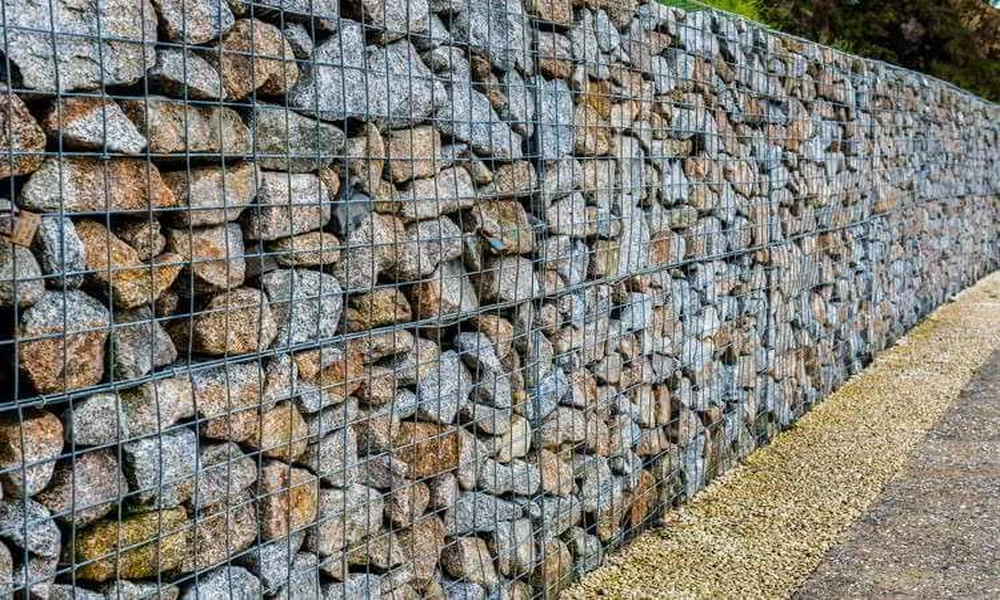
There is a slope somewhere on a lot of properties that never behaves. It sheds soil after heavy rain, undercuts a patio, or slowly pushes a fence out of plumb. The reflexive fix is a poured concrete retaining wall, because concrete reads as permanent and serious. It is worth pausing before that pour, because the wire basket full of rock sitting quietly in the background of so many modern gardens often does the job better, and for less.
Those baskets are gabions, and they have been holding back earth for well over a century. What changed recently is that they crossed over from pure civil engineering into the residential palette, where they now double as walls, seating, planters, and privacy screens.
What a gabion actually is
Strip away the styling and a gabion is a welded steel mesh box filled with stone. Panels clip together into a cube or a low wall, the cavity gets packed with rock, and the assembled units stack and tie into one another. The engineering firm Maccaferri industrialized the modern version in Italy in the late nineteenth century for river control, and highway departments have leaned on the same principle for erosion works ever since.
The residential versions come in a spread of sizes, from small eighteen-inch cubes up to large units several feet on a side, in two broad grades. Lighter four-millimeter mesh suits decorative walls and columns; heavier five-millimeter wire is built for retaining loads. Suppliers like stonedecorative.com ship the baskets flat with the binders and clips included, and the buyer supplies or orders the stone fill separately, which is where a chunk of the flexibility lives.
The case for the cage
Start with drainage, because it is the quiet reason gabions outlast their reputation. A solid concrete wall dams the water moving through a slope. That water builds pressure behind the wall, and hydrostatic pressure is what cracks and topples retaining walls more often than the weight of the soil itself. Engineers fight it with weep holes and drainage gravel and geotextile, all of which can clog.
A gabion sidesteps the whole problem. Water passes straight through the gaps between the stones, so there is no pressure to build. The structure is what engineers call free-draining by default, no weep holes required.
A concrete wall fights the water. A gabion simply lets it through, which is why it is so hard to make one fail.
Gabions also flex. Ground settles, freezes, and heaves, and a rigid concrete wall answers that movement with cracks. A gabion is a flexible mass; it can deform slightly and settle with the ground while staying intact. Over years of freeze-thaw cycles that tolerance is the difference between a structure that ages gracefully and one that spiders with fractures.
Longevity is the third quiet advantage, and it comes down to coating. Quality baskets are made from Galfan-coated steel, an aluminum-zinc alloy that resists corrosion far longer than plain galvanizing, which is why highway and rail projects trust the same mesh in wet, exposed cuttings for decades. The stone fill, meanwhile, does not rot, rust, or degrade at all. Barring physical damage to the wire, the structure’s working life is measured in decades, and even then a compromised panel can be opened and repacked rather than demolished.
Where concrete still wins
None of this makes concrete obsolete. For a tall, load-bearing wall against a steep grade with a driveway or structure above it, an engineered concrete or block wall with proper footings is often the right and code-required answer. Concrete also gives a smooth, sealed face where a gabion gives a rough, permeable one, and in a tight urban courtyard that clean surface may simply be the look you want.
Footprint is the other honest tradeoff. Gabions are gravity structures that resist earth through sheer mass, so a tall one needs real depth at the base. Where space is tight, a slim engineered concrete wall does more with a thinner profile. The comparison is not gabion-good, concrete-bad. It is a matter of matching the structure to the slope, the load, and the space.
Labor is worth weighing honestly too. Filling baskets by hand is genuinely heavy work, and a large wall means moving tons of rock one shovelful at a time. Concrete shifts that effort to formwork, mixing, and a pour that has to be timed and finished before it sets. Neither is effortless. The difference is that a gabion can be built in stages over several weekends by one determined person, while a concrete wall tends to commit you to a single, unforgiving window of work.
The part nobody mentions: it looks good doing it
Function aside, gabions have earned their place in contemporary landscape design because they photograph beautifully and age in the right direction. The stone face reads as texture and permanence, and designers exploit that. The same basket that retains a slope on one property becomes a raised planter, an outdoor bench, a fire-pit surround, or a slatted privacy screen on another.
The fill is where personality enters. Angular quarried stone gives a crisp, architectural face; rounded river rock softens it; recycled brick or even glass turns the cage into something closer to a sculpture. Because the mesh simply holds whatever you pour in, one product supports wildly different finishes, which is a flexibility poured concrete cannot match without formwork and expense.
There is an environmental angle worth naming too. A gabion can be filled with locally sourced or reclaimed stone, cutting the transport and cement footprint that a poured wall carries by default, since cement production is one of the more carbon-intensive materials in any build. The baskets also invite life in. Over a season or two, moss, sedum, and small ferns colonize the crevices between the stones, and the gaps offer shelter to insects and small creatures, so a gabion wall can green over and soften in a way a sealed concrete face never will.
Reading the slope before you buy
Before ordering anything, be honest about what the slope is doing. A low decorative terrace or a garden divider under a few feet is comfortable DIY territory with lighter baskets and a level, compacted base. A serious retaining job holding back a real load is a conversation with a professional and very likely a permit, whatever material you choose. The mesh grade, the base preparation, and the stone size all follow from that assessment, not from a catalog photo.
Get the read right and the wire basket keeps rewarding you. It drains itself, tolerates the ground’s movement, carries almost any stone you feel like packing into it, and looks better the longer it sits there. For a slope that keeps failing, that combination is difficult for a slab of concrete to beat.
