
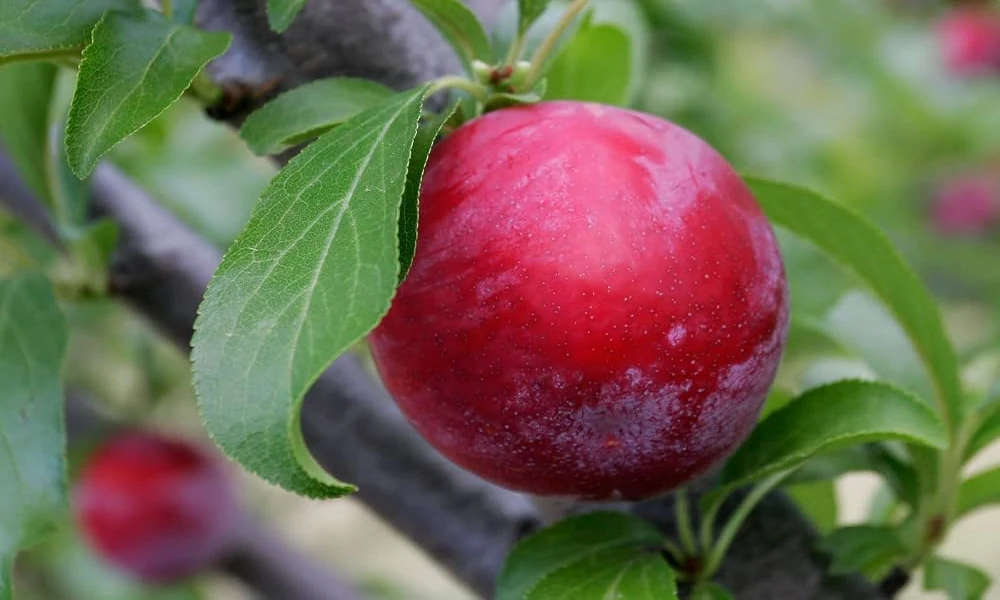
The useful plum harvest is the one that arrives when somebody is there to pick it. A tree heavy with ripe fruit can be a delight in one household and an awkward glut in another. When choosing plum tree suppliers in Britain, the timing of the crop deserves a place beside flavour and the room available for the tree.
A pair of varieties can spread the work, especially when their seasons complement each other. The dates will move with the garden and the weather, so a nursery’s harvest calendar is best used to establish an order of ripening. It should not be treated as a booking for one particular week.
The tree itself also determines how that harvest will be managed. Fruit hanging over a path, beyond easy reach or above a crowded bed is harder to collect promptly. The cultivar, rootstock and supplied shape belong in one decision: a plum chosen for its season still needs to fit the ground.
Following the crop through the supplier choices
The eight entries compare real plum offers, with particular attention to the varieties available, their relative harvest season and the forms offered for planting. The list begins with CRJ Fruit Trees and Avalon, then moves through a wider seasonal selection, a compact group of familiar cultivars and several ways of buying Victoria.
This is a guide to those purchasing choices, assembled from supplier descriptions and horticultural guidance. It does not claim results from testing nursery stock. The earlier entries provide more scope to compare the harvest itself; later ones become useful when the cultivar is already chosen and the remaining decision concerns the plant or order. UK coverage refers to the market for the guide, with delivery dependent on the supplier and destination.
Best 8 Plum Tree Suppliers for British Gardens
1. CRJ Fruit Trees
Avalon offers an appealing starting point for British gardeners preparing to buy fruit trees for a plum harvest that can be used both fresh and in the kitchen. The range gives this variety two different growing scales through St Julien A and Pixy rootstock options.
The supplier places Avalon ahead of Victoria in the ripening sequence, describing a usual gap of roughly ten days. That relative timing is more useful for planning than expecting the same picking date in a sheltered southern garden and a cooler site farther north. A household that already has access to Victoria could investigate Avalon as an earlier contribution, while allowing for overlap.
There is a pollination decision too. CRJ Fruit Trees recommends a partner for Avalon and names options including Victoria and Marjories Seedling. RHS describes Avalon as partially self-fertile. In practical terms, planting with compatible pollen available is the stronger plan than relying on a solitary tree to produce a consistent crop.
The rootstock choice then sets the scale. Pixy offers more restriction than St Julien A, while the latter suits a larger framework. This combination of cultivar, partner and size makes the offer useful at the beginning of a plum project. The reader can plan a manageable sequence of fruit without treating every tree in the range as the same size.
2. Walcot Organic Nursery
Walcot’s catalogue supplies the bones of a summer calendar. Early Prolific is listed for mid-to-late July, Opal for early August and Marjories Seedling for early-to-mid September. Victoria, placed in late August, supplies another reference point between them. A gardener can see which part of the season a new tree would add before choosing its roots.
Take a household already picking Victoria in late summer. Early Prolific would move the prospective start earlier; Marjories Seedling would take the plan towards September. Opal and Early Prolific may overlap locally, so two early trees should be bought for their fruit as well as for a hoped-for extension. A cooler summer can shift the dates without removing the value of this broad sequence.
The named maiden offers also make the tree choices concrete. Early Prolific is on St Julien A; Opal and Marjories Seedling have Pixy and St Julien A options. Their available growing space can be assessed separately from the picking calendar. These variants were listed for seasonal supply when checked. Walcot ranks highly because its actual young trees let the reader turn a desired sequence into a planting enquiry, with named cultivars at the beginning, middle and end.
3. Chew Valley Trees
Chew Valley’s Opal and Czar bring the comparison into the early part of the plum season. The nursery places the beginning of Opal picking in late July, potentially continuing over several weeks, and Czar in early August. That proximity matters: buying the pair would not automatically provide widely separated harvests.
Their kitchen roles give another reason to choose. Opal is described as a dessert plum, with juicy yellow flesh; Czar is dual-purpose and needs to be fully ripe for fresh eating. A household mainly wanting fruit to eat outdoors may lean towards Opal. One happy to cook some of the harvest has a reason to consider Czar. Both are listed as self-fertile, although a suitable site and growing conditions still influence the crop.
Avalon and Victoria complete the nursery’s four-variety group. Four familiar cultivars keep the comparison concise, while the Opal and Czar descriptions supply actual picking periods and uses to set beside their names. The relevant container-grown variant and its current availability should be agreed for the planting. Here the gain is a clearer choice within early summer fruit, rather than a promise that any two trees will eliminate a glut.
4. Victoriana Nursery Gardens
A household with a place for Victoria can obtain a containerised St Julien A tree from Victoriana. It is pruned to approximately 90-120cm including the pot. That modest starting plant leaves the crown to develop in the garden, where its future branches can be kept accessible for the concentrated work of picking.
Reserve the room around the tree before it arrives. St Julien A supports considerably more growth than the delivery measurement suggests, and an easy-to-handle pot does not make the mature tree a patio miniature. The offer suits an open-ground Victoria project with a prepared position and time to develop its structure. Its harvest contributes the chosen Victoria season; an earlier or later crop would require another cultivar, with space allocated separately.
5. Roots Plants
Roots lists a Victoria patio tree in a 4.5-litre pot, around 60-90cm on arrival. The reviewed potted variant was available, while other varieties and bare-root versions had their own stock or pre-order status. That makes the exact selection important.
This is a small supplied plant that can appeal to a gardener beginning with a container. The word patio describes how it is marketed; long-term size and care still depend on the plant and growing method. A buyer should establish the rootstock attached to the selected Victoria variant before planning to keep it permanently in a restricted space.
The comparison with Victoriana is therefore about the actual product, including its container and arrival size. It is not a contest between two names for the same mature tree. For a patio grower, access to water and enough room for the developing branches will matter throughout the growing season.
Roots adds an obtainable potted route to a familiar harvest. Its wider listing includes Opal and Jubilee variants, but their availability cannot be assumed from the Victoria stock label. A small planting plan works best when every intended tree is confirmed individually.
6. Blackmoor Nurseries
Blackmoor supplies Victoria through a direct nursery order for the dormant season, with the age and form selected at purchase. For a cook who expects to use the crop promptly, this establishes a familiar summer plum while leaving the young framework to be fitted to the garden.
Victoria is self-fertile, so one tree can be the whole plum plan. A second planting position could instead be saved for Early Prolific or Marjories Seedling if a longer sequence is wanted. That is a more consequential decision than duplicating the same harvest through another order. Space for a spreading crown and access for thinning are particularly helpful with Victoria: a heavy crop can put considerable weight on its branches. Blackmoor’s seasonal route works when the planting place is ready and that future crown can be tended comfortably.
7. Keepers Nursery
Keepers gives Victoria buyers a rootstock comparison within its young-tree offer. The reviewed listing includes a maiden on Pixy, allowing a more restricted framework to be considered alongside the larger-growing plum options elsewhere in this guide.
A maiden asks the gardener to begin the structure. That can be attractive when the first branches need to be developed for a particular site, although it calls for a clear plan for formative pruning. For plums, that work follows stone-fruit guidance and suitable growing-season conditions.
The Pixy choice is relevant where the household wants Victoria but has less room for a broad tree. It also provides a reason to compare this purchase with the St Julien A offer above. The difference is attached to the roots and the work ahead, not to the familiar fruit name.
Keepers accepts orders for winter supply, with each variant carrying its own availability. If the intended rootstock sells out, reconsider the dimensions before accepting another. A replacement tree that fits a different space may be a poor substitute even when it produces the desired plum.
8. Adam’s Apples
Adam’s Apples includes Victoria as a maiden on St Julien A in its seasonal fruit-tree offer. Its mixed-order structure is useful when the plum is one part of a larger garden planting rather than a stand-alone purchase.
That might mean Victoria beside apples and pears whose later crops spread the household’s fruit season. The plum does not need to perform every role. It can provide one useful summer harvest while other trees carry the garden into autumn, with each allocated enough room to mature.
The nursery’s mixed quantities allow the buyer to assemble that planting without automatically ordering several of the same plum. Young trees also establish a project at a similar stage, making early watering and protection easier to organise across the new planting.
This is the most relevant choice here for someone already composing a mixed group and content to raise Victoria from a maiden. The winter dispatch timetable should be coordinated with the whole order. A single thoughtfully placed plum can contribute more than an extra tree squeezed between future crowns.
Make room for the picking season
Choose the summer period first, then the tree that can serve it. A variety ahead of Victoria may extend an existing crop; a later one may be more useful where early fruit is already plentiful. A containerised Victoria or a restricted maiden answers a different need: obtaining a manageable plant of a cultivar already chosen.
Allow access for picking, pruning and removing damaged fruit. Those practical details help the harvest stay useful as the tree grows. The best plum selection is one the household can tend and enjoy when the fruit is ready.
Source note: Supplier plum catalogues, individual variants and seasonal ordering terms informed this guide. RHS plum information supports the pollination distinctions and growing context; harvest periods remain dependent on local conditions.
