
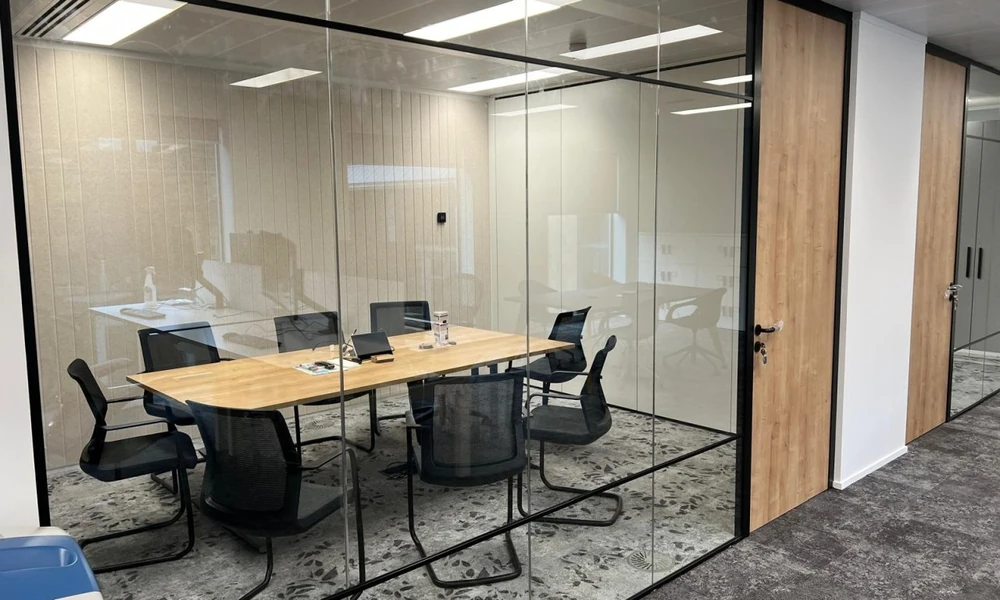
Open plan was sold as collaboration and delivered distraction. The research since has been fairly consistent, removing barriers increases interruptions and pushes people into headphones, which is a private office made of foam. The corrective is not a return to cellular offices but a considered use of partitions for office environments, placed where they solve a specific problem rather than uniformly across a floor.
Identify Which Problem You Are Solving
Three distinct complaints get lumped together. Visual distraction is movement in peripheral vision, solved by a screen roughly at seated eye level. Acoustic distraction is intelligible speech, which is far more disruptive than general noise because the brain cannot ignore words it can understand. Confidentiality is the risk of being overheard or overlooked, relevant in HR, finance and clinical settings. Each requires a different height, material and position, and a partition chosen for one will not fix the others.
Height Determines Effect
A screen at desk level tidies cabling and does nothing else. At around 1.2 metres it blocks sightlines between seated colleagues while preserving the sense of an open room, which is the most common specification. At 1.6 metres it blocks standing sightlines and begins to feel enclosed. Full-height systems create rooms and trigger requirements around ventilation, lighting and fire safety. Going higher than the actual problem requires makes a floor feel cramped and reduces the daylight reaching the centre of the space.
Acoustic Performance Is Not Automatic
A hard glass or laminate screen reflects sound rather than absorbing it and can make an area worse by bouncing conversation around. Genuine acoustic performance requires a sound-absorbing core, usually mineral wool or high-density PET, behind a permeable fabric facing. Look for a stated absorption rating rather than a claim of being acoustic. Partitions also work best alongside soft ceiling and floor finishes, since a screened workstation in a room of glass and concrete will still be loud.
Materials in Practice
Fabric-faced acoustic panels perform best for sound and offer a pinnable surface, at the cost of showing marks over time. Glass preserves light and sightlines and suits meeting rooms, with frosted or manifested bands for privacy and safety. Laminate and melamine are hard-wearing and easy to clean, which matters in industrial and food-related settings. Combination panels with a solid lower section and a glazed upper section are popular because they give privacy at seated height without darkening the floor.
Desk Screens, Floor Systems and Rooms
Desk-mounted screens clamp to the worktop, move with the desk and suit teams that reconfigure often. Floor-standing screens are freestanding and can define zones without touching the furniture, which is useful in leased premises where fixing to the structure is restricted. Modular full-height systems build enclosed meeting rooms and offices from demountable panels, and can be dismantled and reused at the next premises. Which of these suits you depends less on budget than on how often the layout will change.
Cable Management and Power
The most useful secondary function of a partition system is hiding cabling. Screens with an integrated cable tray or a void behind the panel let power and data run along a desk run without trailing across the floor, which matters for appearance and for tripping hazards. Some systems accept power and data modules mounted directly into the panel at desk height, removing floor boxes from the equation entirely. Decide this before installation, because retrofitting cable capacity into a screen that was not designed for it usually means visible trunking.
Light and Ventilation
Screens change how a floor feels as much as how it sounds. Tall solid panels across a window aspect will cut daylight to the interior and make an open plan area feel like a maze, and in an air-conditioned office they can obstruct airflow enough to create warm pockets. Glazed upper sections, lower heights along circulation routes, and gaps at the ends of runs all help. Walk the space at eye level before finalising a layout, because a plan view gives no sense of what the room will actually feel like.
Layout Matters More Than the Panels
The most effective intervention is often positional. Screening the ends of desk runs that face circulation routes removes most passing distraction at a fraction of the cost of screening every workstation. Placing absorptive panels between facing desks addresses the conversations people actually overhear. Keeping the sides of workstations open preserves the collaboration open plan was meant to deliver. Effective office partition systems are targeted rather than comprehensive.
Regulations and Building Constraints
Full-height partitions affect fire compartmentation, sprinkler coverage, smoke detection, emergency lighting and escape routes, and works of that kind require proper approvals and a qualified contractor. Landlords in commercial buildings typically require submission of layout drawings and reinstatement at the end of the lease. Freestanding and desk-mounted screens generally avoid these requirements entirely, which is one practical reason they dominate in leased offices.
Specifying and Buying
Measure the space and mark the actual desk positions before selecting anything, then choose height by sightline, material by acoustic need and finish by cleaning regime. Ask about lead times, whether installation is included, and how panels are reconfigured later, since a system requiring the supplier for every change becomes expensive. Well-chosen partitions for office use should be quietly unremarkable once installed, with the only noticeable outcome being that people can concentrate.
